JACKZER

A JACKZER Guide

Safety Rating
in iRacing.

Safety Rating is the gatekeeper. It decides your licence, the cars you can drive, and whether you get into the big events. Most people are quietly tanking it without ever understanding it. This is the whole thing, in plain English, with the bit nobody explains properly: why the cleaner you get, the more each mistake costs you.

15 min readiRacingBeginner to Advanced

Clear this up first

Two numbers. They measure completely different things.

The single most common confusion for new members. iRating and Safety Rating are entirely independent. One is how fast and how well you race. The other is how cleanly. You can be brilliant at one and a disaster at the other.

iRating

How well you race

A skill rating. It moves on where you finish relative to who you raced. Beat people rated above you and it climbs. It is a zero sum system, so for every point you gain somebody else loses one.

It does not care how clean you were. Only the result.

Safety Rating

How cleanly you race

A safety record. It moves on how many corners you complete and how many incidents you pick up. Finishing position does not enter into it at all.

This is the one we are here for. Everything below is Safety Rating.

“I won the race but lost Safety Rating, what's wrong?” Nothing is wrong. Safety Rating has no idea you won. It only saw the incidents you collected getting there. Win dirty and the number still drops.

The whole idea, in one line

Safety Rating is corners per incident.

That is the engine under the whole system. iRacing counts how many corners you drive through, and how many incident points you pick up doing it. More clean corners per incident, the number goes up. Fewer, it goes down.

Think of it like a bank account. Every clean corner you complete is a small deposit. Every incident is a withdrawal, and the bigger the incident, the bigger the hit. Stay in credit across your recent racing and your Safety Rating climbs.

This is why finishing matters, why long tracks are gold, and why one big shunt can be diluted by a thousand clean corners. Hold that one idea and the rest of the page falls into place.

The Safety Rating account

  • 180 clean corners+ deposit
  • 1x off track- small
  • 240 clean corners+ deposit
  • 4x heavy contact- big
  • 300 clean corners+ deposit
Net across the windowIn credit

Stay in credit over your recent races and the number climbs. The big withdrawal only sank you if the deposits weren't there.

The withdrawals

What actually counts as an incident.

Four values. Knowing them changes the decisions you make in the heat of a corner, because once you can see the price tag you start picking the cheaper option on purpose.

  • 0x

    Light contact

    Logged, but it adds nothing to your count. A gentle touch the system noticed and let slide.

  • 1x

    Off track

    You ran too far off the racing surface. The cheapest mistake there is, and the one you can usually choose on purpose to avoid a bigger one.

  • 2x

    Spin or wall

    A loss of control past ninety degrees, or contact with a wall or object. Two ways to earn the same two points.

  • 4x

    Heavy contact

    A meaningful hit with another car. Even a fairly soft one can be flagged 4x if the sim decides it mattered. On dirt it scores 2x, because contact is part of the game there.

The one that saves you points

When several incidents happen in quick succession, only the biggest is counted. Spin and then clip a wall in the same moment and you take the one score, not both. It is also why a 1x off onto the grass is so often the smart play. A controlled trip across the run-off is far cheaper than staying on the racing line and earning a 4x in the pile-up.

A short memory, on purpose

You are only as safe as your last 15 races.

Safety Rating is a weighted moving average. Recent corners count the most. Corners from around ten races ago fade out of the sum entirely. The rough window everyone settles on is your last 10 to 15 races.

iRacing does this deliberately. If the calculation stretched back over a thousand races, a veteran would build total immunity to incidents and could drive like a lunatic with no consequence. The short window keeps everyone honest. Past sins are forgiven, but so is past good behaviour.

The flip side is the hopeful one. A bad week is not permanent. String together 10 clean races and the messy ones literally age out of the maths.

What the calculation can see

Latest race~15 races ago, fading out

Beyond the window, your old corners stop counting. A clean run of recent races is the only thing that moves the number, in either direction.

The bit nobody explains

Why you gain less, and lose more, the higher you climb.

This is the part that frustrates people for years. You get cleaner, you climb, and suddenly the same incident that meant nothing as a Rookie is hammering your rating. It is not a bug. The standard you are measured against gets tougher at every step.

Incidents you can average per race and still hold the class (Lime Rock, 140 corners)

Rookie
9.3
Roomy. You can have a scrappy race and barely move.
Class D
6.2
Class C
4.1
Class B
2.8
Class A
1.8
Tight. Under two incidents a race just to stand still.
Pro
1.2
Brutal. Barely one.

Same track, same corners. A Rookie can pick up 9.3 incidents a race and hold station. An A class driver gets 1.8. That is the whole story in one chart. A class racing is roughly five times cleaner than Rookie racing, because the people there are held to a five times tighter line.

4x in a Rookie race

The Rookie on 3.00

Safety Rating rises

Four incidents in this race is well inside a Rookie's budget. Their average is still drifting up toward the cleaner C class standard, so the number goes green.

4x in a Rookie race

The A class driver on 3.00

Safety Rating drops

Same race, same four incidents. But four is way over an A class budget. Their average is being dragged down toward C class, so the identical race punishes them.

Same race. Same incidents. Opposite outcome.

I want to be honest about where the clearest version of this comes from. There is an iRacing member guide from 2010 that is genuinely hard to find now, and although it is old and some details have changed since, I still think it is one of the best explanations of how Safety Rating works ever written. So I am pulling from it directly. Here is the line that makes it click.

“Take two drivers who both get four incidents in a Rookie race at Lime Rock. If driver A was a Rookie on 3.0, his Safety Rating would rise, as his average would be moving up toward a C class licence. If driver B was an A class driver, his Safety Rating would be moving down toward C class. Thus, the standards are different.”

iRacing member guide, 2010

There is a second reason the top end stings. When your corners per incident is already high, you are running on a clean average with very little fat on it. A single 4x is a much bigger spike relative to that tidy number than it would be against a messy one. The cleaner you are, the less an incident has to compete with, so the more it shows.

Where the number takes you

The licence ladder, and how you move on it.

Six classes. Inside each one, your Safety Rating runs from 0.00 to 4.99. Cross the top and you are knocking on the next class. Slide too far and you fall back down.

Lowest to highest

  • ProTop class0.00 to 4.99
  • Class A0.00 to 4.99
  • Class B0.00 to 4.99
  • Class C0.00 to 4.99
  • Class D0.00 to 4.99
  • Rookie0.00 to 4.99

Every class holds the full 0.00 to 4.99 range. The Safety Rating you see is your position inside your current class, not across all of them.

Below 1.00

Instant demotion

Drop under 1.00 and you don't wait for the season to end. You go down a class there and then.

Below 2.00

Demotion at season end

Finish the season under 2.00 and you'll be moved down when the new season starts. The danger zone.

2.00 to 2.99

You hold station

Safe. You keep your class. No promotion, no demotion. Just steady.

3.00 and up

Promotion at season end

Finish a season on 3.00 or higher with your Minimum Participation Requirement met and you move up a class.

4.00

Fast Track, promote now

Hit 4.00, or 3.00 as a Rookie, with your participation met and you promote immediately, mid-season. No waiting.

The buffer trick

Fast Track promotions and the double-up.

A Fast Track promotion at 4.00 doesn't dump you at the bottom of the next class. It lands you partway up it, often somewhere around the mid 3s, with a buffer underneath you. That buffer is the opportunity.

From there, a clean race or two can push you back to 4.00 and promote you again, quickly. A high-corner track and a tidy run is all it takes. People call it a double promotion, and it is completely legitimate. iRacing is just doing its job, moving a safe driver up fast.

Time trials count toward your Minimum Participation Requirement, so if you only need the participation box ticked, a few quiet time trial laps will do it without the chaos of a race.

One honest warning, and it is the same one I give in the video. What goes up fast can come down fast. Don't double-promote yourself into cars you aren't ready for. Use the buffer to race a class you enjoy with breathing room, not to throw yourself in over your head.


Not every lap is equal

Session weighting, the free Safety Rating most people leave behind.

Incidents and clean corners are weighted by the type of session they happen in. The race is full value. Everything around it is discounted, which cuts both ways. A scrappy practice hurts less, and a clean practice still pays.

  • Test session0Doesn't count at all. Bin it as much as you like.
  • Practice (official)LightThe practice before a race counts, at less than the race.
  • Time Trial0.35
  • Qualifying (lone, oval)0.35
  • Qualifying (lone, road)0.50
  • Warm-up0.50
  • Race1.00Full weight. The most to gain and the most to lose.

Practical

Drive the whole of the official practice and the whole of qualifying, cleanly, before the race even starts. Every clean corner banks a little Safety Rating and warms your hands up at the same time. It is the easiest credit on the board, and almost nobody collects it.

Now go and use it

The playbook for actually climbing.

Everything above turns into a handful of habits. None of them are about being fast. They are about being there at the end, cleanly, with the most corners and the fewest incidents you can manage.

01

Before the lights

  • Bank the practice

    Drive the full official practice cleanly. Free Safety Rating, a warm-up, and a feel for the track all in one.

  • Drive all of qualifying

    Out lap, your hot laps, then keep circulating to the flag. Don't park it after your banker, and don't bin it trying to find more.

  • Qualify well

    The higher you start, the less first-lap carnage there is in front of you to get caught in.

02

In the race

  • Survive turn one

    Don't treat the first corner like the last lap. Read the chain of brake lights ahead, be predictable, get through it alive.

  • Don't overdrive

    Grip is a budget. Smooth, slightly-under-the-limit inputs keep the car listening to you and keep you on track.

  • Be ready for carnage

    When it goes off in front of you, a 1x across the grass beats a 4x in the pile. Sometimes you stop. If you do, watch your mirrors.

  • Never quit

    Finishing dilutes your incidents across far more corners. That 4x spread over twenty laps barely registers. Spread over three, it stings.

03

The edges

  • Keep driving after the flag

    Watch your lap timing box. Until the timer flips to the server-close countdown, your laps still bank Safety Rating at full race weight. Steal a clean lap or two.

  • Choose high-corner tracks

    Safety Rating is per corner, so a lap of the Nurburgring is a goldmine. Stay clean there and your average rockets.

  • Practice how you race

    Habits carry over under pressure. If you're sloppy in practice, you'll be sloppy when it counts. Treat every lap like it matters.

And the five that quietly tank it

Turn one chaos

Treating the first corner like the last lap.

Rage quitting

Leaving early concentrates the damage instead of diluting it.

Overdriving

Past the limit, the car ignores you and the offs pile up.

Skipping quali

Starting at the back walks you straight into the pile.

Frozen in carnage

Not deciding early to take the cheap escape route.

A note on blaming other drivers

It's a no-fault system. That's the point.

iRacing doesn't assign blame. In real contact, both drivers usually take the points. It sounds unfair until you remember the alternative. A fault-based system gets gamed. People learn exactly where a tap of the brakes drops a penalty on someone else but not on them. No-fault means both drivers lose, so both have every reason to avoid the contact.

Here is the line from that old guide that has stuck with me, and it is pure sports psychology. The share of your Safety Rating made up of other people's mistakes is usually quite small. If it genuinely isn't, that is information. It means you are accepting too much risk, sitting in the wrong places, trusting gaps that aren't there.

You can't control the other twenty cars. You can control the distance you give them, the spots you pick, and the risk you accept. Almost everyone learns to manage that with time. The ones who never do stay frustrated forever, blaming everyone but themselves. Don't be that driver.

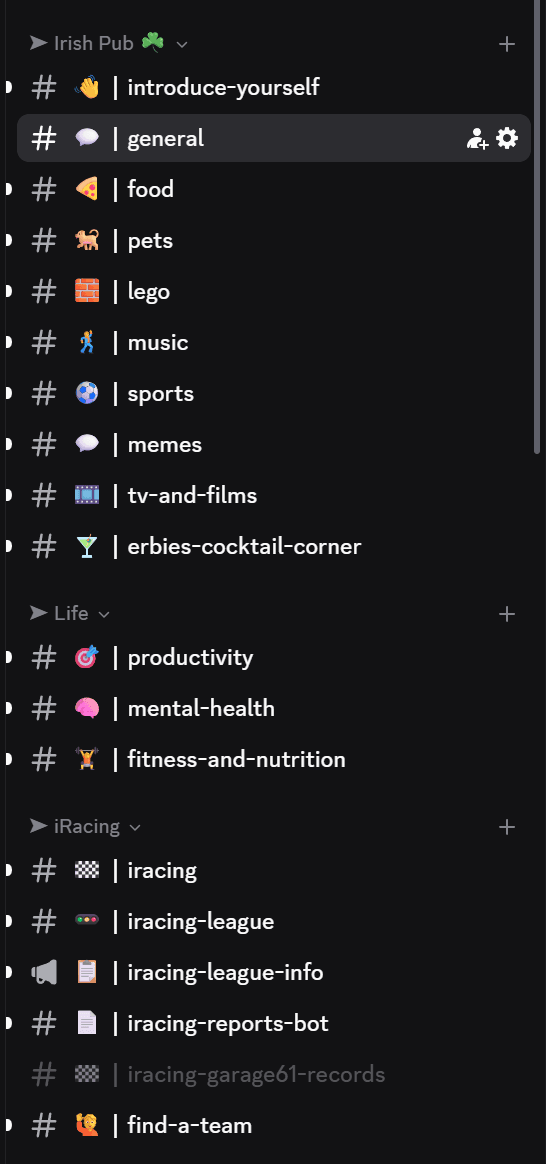
Join our Irish Pub Community Discord with over 3.4K members.

The Irish Pub would love to have you, we've league races on Thursdays and the craic is mighty. Can't wait to see you there.

A peek at the JACKZER Discord channel list
JACKZER showing the SIMAGIC Zeus to a young racer

Channel partners