SIMAGIC
The full SIMAGIC bundle deal. Direct-drive base, wheel and pedals at the lowest price of the year.

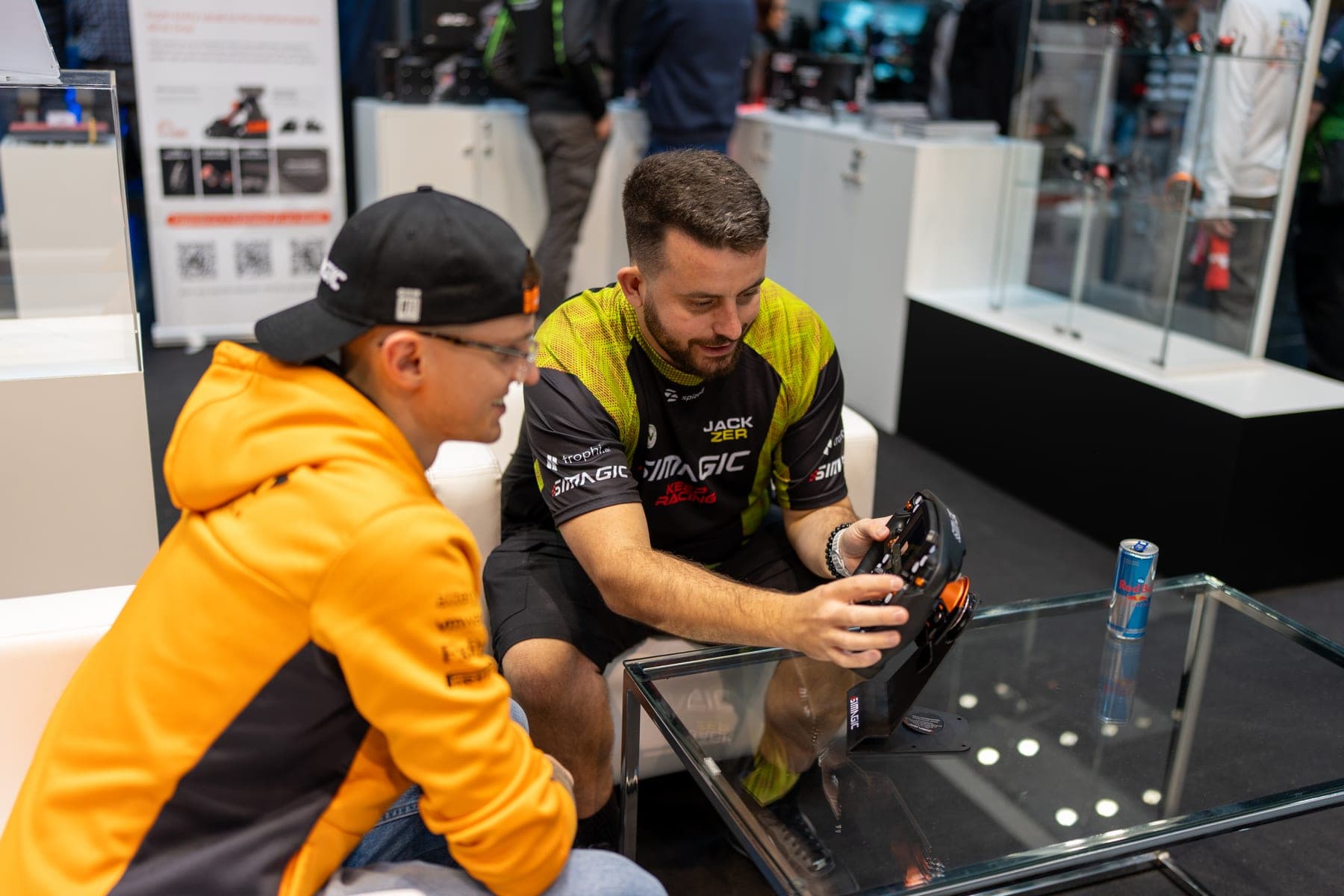
A JACKZER Guide
What I'd buy, what I'd skip, and the gear I actually race on. I'm a SIMAGIC ambassador, fully disclosed up top, so this isn't a review. It's the conversation I have when people corner me at meetups and ask which wheelbase, which wheel, which pedals.
Start here
Full transparency, I'm a SIMAGIC ambassador. Have been since I moved from a Fanatec CSL Elite to the Alpha Mini years back. I love the gear and race on it every day.
This isn't a review. There are plenty of those out there and you should go read them. This is for the person who's already decided on SIMAGIC and wants someone to honestly walk them through what fits who, what to upgrade now, and what to leave on the shelf.
I'll tell you what I'd buy, what I'd skip, and where I've regretted my own purchases. That's the whole brief.
What this guide isn't
What's new
Since I first put this guide together, SIMAGIC rolled out a whole new wheel family, the Zeus series. Three shapes, all built around the MagicDash 4 screen that clicks on magnetically. They're on pre-order now and ship from June 10. I've folded them into the wheels section below, but here's the quick version so you know they exist before you spend.
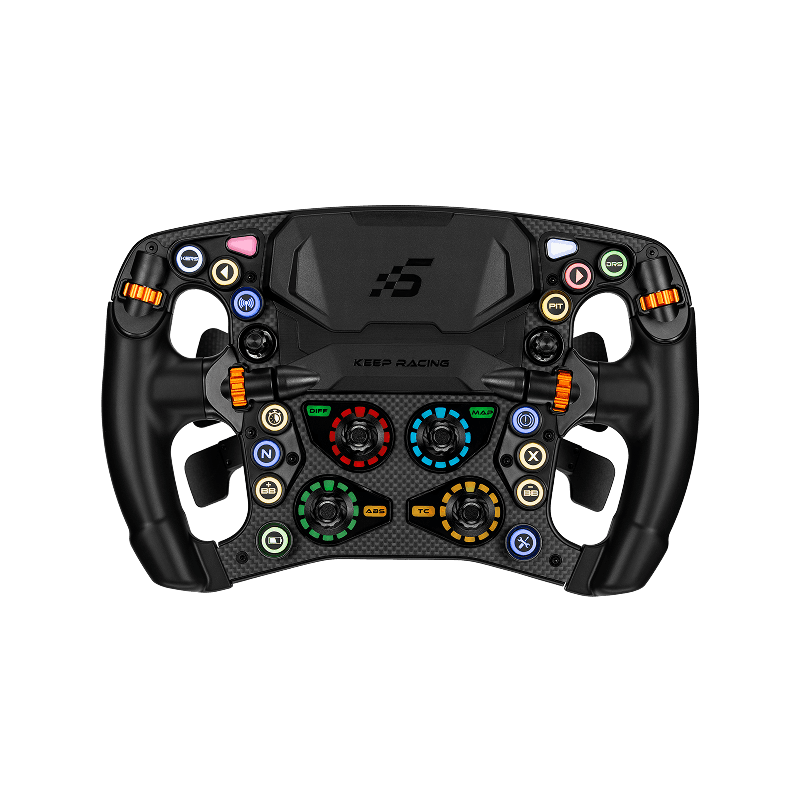 $499
$499280 mm F-style wheel. Ships with MagicDash 4 integrated.
 $349
$349300 mm modular GT wheel, MagicDash 4 optional.
 $329
$329320 mm round wheel. Built for GT, touring, drift and rally.
The buying principle
The single most useful thing I can offer before you go near a checkout button. Picture yourself in two, three, five years. If the wheelbase you're about to buy already has you saying “I'll upgrade this in a year” before the box is even open, sit with that for a minute. That's a doubt, and the goal at the point of purchase is to remove as much doubt as you can.
I bought my Alpha Mini and adored it. About two years in I quietly regretted my pick. Not because the Mini was bad, it's a tank. Because I'd chosen to save money on the base so I could put more into the wheel, and at the time I didn't have the experience to know the curiosity for more torque would creep in. If I went back I'd still buy the Mini, because I didn't know what I didn't know.
You can't always avoid that pull, especially if you're new. Where you can, take the extra step on the base. An extra $150 to skip a rung you'd climb in a year is almost always cheaper than upgrading later, and you carry zero remorse into your first season on the new gear.
The juicy stuff
SIMAGIC have two generations on sale at the same time. The original Alpha line and the current Alpha EVO line. Same philosophy, different platforms.
If you're buying new
Buying new, EVO every time. It's the platform SIMAGIC are actively investing in. Long-term firmware updates, future compatibility with whatever simulator drops next, all of that sits with the EVO line.
That doesn't make the Alpha bases bad. Quite the opposite, the Alphas are monsters. Read any SIMAGIC review out there and they hold up extremely well. The Napman put it best in a recent interview, “just because something is newer doesn't always mean it's better.” That applies fully to the Alpha line.
The one situation where I'd send you toward an Alpha over an EVO is if you spot a real steal of a price. A second-hand find from someone upgrading, a clearance on a new unit, anything where the discount is genuinely strong. The bases are tanks, if the connections on the back are healthy, you've got yourself a serious piece of kit for not a lot.
Practical
Of the Alphas, the only one I'd still recommend brand-new is the Alpha Mini. 10 Nm, around $359 on a sale, an honest entry into direct drive. Anything stronger in the Alpha line, you're better off jumping to the equivalent EVO and getting the longer support life.
9, 12, 18, or 28 Nm
Four EVO bases, same architecture across the line. You're picking torque and price, not a different product. Speed, fidelity, encoder all sit at the same level. Higher torque bases also stay quicker and cooler under load, which is worth knowing if you race long sessions.
The 9 Nm Sport is competitively priced and a fantastic entry into the EVO platform, especially coming from a belt-drive base. Honest take, 9 Nm leaves me curious. Not because it's weak, plenty of torque for most cars, but because once you settle in you'll wonder what one rung up feels like.
The 12 Nm EVO is the meet-most-people sweet spot. Enough force for any car or category, very few people outgrow it, and the price gap to the 18 Nm Pro is small enough to make the call easy. If you're asking me where to land, that's the answer. The 12 is the money.
The 18 Nm Pro is my personal pick. Same EVO character, a little more push than the 12, and I just like a touch more weight in the wheel than most. I rarely run it at full chat, the headroom is what I'm paying for, not the strength.
The 28 Nm EVO Ultra is the flagship. Almost nobody needs to run all of it, the value of stepping up is in the speed and the fidelity of the platform, not in being able to hit 28 Nm. If money isn't the constraint and you want one base for the next decade, this is the one.
Practical
If you're asking what I'd steer a friend toward, the 12 Nm EVO covers nine out of ten cases. The Pro covers the remaining one if you, like me, just prefer a stronger wheel.
One spec sheet detail worth flagging
Worth knowing before you order. The Alpha EVO bases don't do front mounting out of the box. The original Alphas did. SIMAGIC made a design call to drop it, and there's now an optional bracket to bring it back.
If your rig is front-mount only, you'll need that bracket. It works on Sim-Lab and most aluminium-extrusion cockpits, and I haven't come across a rig where it couldn't be made to fit. Just budget it in. There's also a side-mounting bracket for wheel decks where you want a bit of angular tilt.
The wheels
A hot take to open with, then the picks, including the new Zeus family at the end. The wheel is where most personal preference lives, so this section is more about what I'd steer you toward than what's objectively best.
The hot take, said with love
Sit with this before you splash on a wheel with a built-in display. Unless you're racing in a true formula driving position, where the wheel sits high and centred in your eyeline, the wheel screen is rarely in your line of sight. I race in a GT seat. To check my steering wheel I'd have to look all the way down past my dashboard on screen and past my rev light bar mounted to the bottom bezel of the monitor. By the time my eyes get there, I've missed everything that matters.
The classic curiosity trap is, “I've never had one, so once I have one the wheel will be finished.” Honestly, it usually isn't. The screen is a great feature when it's in your line of sight. When it isn't, it's a feature you paid for and rarely use.
Practical
If you want a rev light, a $25 to $30 rev bar on Etsy mounted to your monitor bezel does the job for the vast majority of people. Let your loved ones know that's a fine gift idea while you're at it.
FX Pro vs FX Formula
If you've decided you want a formula-style wheel, both the FX Pro and the FX Formula (FXC) are excellent. Same shifters, same clutches, same general build. The FX Pro gives you the 4.3 inch LCD on the front and the top two extra paddles I actually love for cycling black boxes.
Personally I'd save the money and go FXC. You lose the screen, you lose the top two paddles, you lose a couple of rotaries that most people just use for volume anyway, and you keep a wheel that's a serious piece of kit. That's a lot of money for things I don't miss in a GT seat.
That said, the FX Pro is in a lovely price spot right now compared to where it used to sit. If the screen has always been the thing you wanted, fair play, get the Pro and enjoy it. Just go in knowing what you're paying for.
The wheel I'd pick today
If a friend asked me for one SIMAGIC wheel pick today, it'd be the GT Neo without much hesitation. Light, stiff, beautifully built, SimHub compatible, optional Mag Link if you want to make it wireless on an older base. For $269 or so it's the bees knees.
The design philosophy on the GT Neo is what sells it. The way it mounts at the rear, by sheer geometry, means it flexes less than a wheel of similar size. Add the firm shifters, the clean button layout, and the fact that it's SimHub-ready out of the box, and you've got one of the best value wheels in simracing right now.
Practical
I usually wrap my wheels in gloves rather than wearing them on my hands. Hacker move, but it sorts the firm-leather problem if you find the GT Neo a touch hard for long stints.
Neo X Hub and the 330T Rally
SIMAGIC have a clear bias toward formula and GT shapes, but the round-wheel side of the family is genuinely strong. Two routes in.
The Neo X Hub is the build-it-yourself route. You get the hub, the paddles, the shifter plates (two or four, you pick), and then you mount whatever round rim you want. Could be a Soul Peek, a GSI, any QR50 rim. The hub is SimHub compatible out of the box and only sets you back around $200. You can absolutely Daniel Newman Racing the lights on it and have a great time.
The pre-built route I'd point you at is the Neo X 330T Rally. Soft leather grip, no stitching, lovely little grooves under the hand. As round wheels go, it's a be of a wheel.
Practical
Pre-built Neo X wheels come with their own paddle set. Different from the Neo X Hub kit, where you can fully spec the shifter plates and customise. If customising the back of the wheel matters to you, the hub is the move.
The new arrivals
The newest thing in the lineup, and the reason I came back to this guide. The Zeus wheels are a fresh family built around the MagicDash 4, the magnetic 4 inch screen that clicks onto the back of the wheel. Three of them, and they line up neatly with the shapes I've already talked through.
The Zeus Formula is the F-style one, 280 mm, and it comes with the MagicDash 4 in the box. If you read my screen rant up top and you're genuinely in a formula driving position, this is where the screen actually earns its keep. In a GT seat the same honesty applies, gorgeous bit of kit, just be straight with yourself about whether you'll look at it.
The Zeus GT is the 300 mm modular GT wheel. The MagicDash is optional here, so you can run it clean and add the screen later if you change your mind. It's a step up in price and finish from the GT Neo, so if you want the modular face and the option of a dash down the line, it's a tidy buy.
The Zeus Sport is the 320 mm round one, aimed at GT, touring, drift and rally. If you want a round wheel and fancy the option of a screen, it's the modern take on the Neo X route I mentioned just above.
Practical
All three Zeus wheels come wired, or fully wireless with the AirLink module, paired with the MagicDash as a single box. They're on pre-order and ship June 10. The honest note, none of this knocks the GT Neo off its perch as my value pick. Zeus is the move if you specifically want the MagicDash screen or the newest platform. If you just want the best wheel for the money, the goat is still the goat.
Pedals
The P700 is the entry pedal, very fair value if budget is the constraint. The interesting conversation lives one level up, between the P1000 and P2000.
One is steak, the other is ham
The naming would have you believe the P2000 is somehow twice the pedal that the P1000 is. That's not really how to read it. Both are top of the SIMAGIC pedal line, both are load cells underneath. They just go in different directions from there.
The P1000 is the classic build. A stack of springs and elastomers inside the brake, swappable, tunable. Threshold braking is a dream on these, dial in the last 20 per cent to get noticeably harder and you'll rarely tip into accidental lockup. The Performance Kit is the unlock, get it.
The P2000 swaps the spring stack for a dual-pump hydraulic system sitting on top of the load cell. Probably the closest feel to a real car brake from any SIMAGIC pedal. Slightly more complex to set up, and you carry the (small) risk surface that comes with any hydraulic system.
Personally I race the P1000s. Simpler, no fluid to worry about, springs I can change in five minutes, and they accept the HPR active-pedal motor on the back. Super GT have been on P2000s for years without trouble, so don't read my pick as a warning. Both are excellent. Try them if you can and go with whichever feels right.
Almost not optional with the P1000s
If you're buying the P1000s, in my opinion the Performance Kit goes in the basket at the same time. It gives you the extra springs and preloads to actually experiment with the feel of the pedal. Try different setups that other people have run, find the one that suits your foot, dial it in over a few weeks.
Without it, you've got the pedals as SIMAGIC shipped them. They're still good. With it, you've got a pedal you can shape into exactly what you want.
The cheat code
For me, the entire appeal of active pedals comes down to one thing. Feeling ABS through the brake. That sharp pulse the moment the system kicks in is what makes you instinctively trail off, exactly the way you would in a real car. Everything else about active pedals is nice, but ABS feel is the bit you actually race with.
The trick. The back of the P1000 brake pedal takes a small haptic motor, the HPR or the cheaper HPR GT. iRacing sends the same ABS information to every brand of pedals on the market. The HPR translates that signal into a real, usable kick under your foot, and for the money we're talking about, it brings the brake to life.
One important note. On iRacing, you only need one. Buy one HPR for the brake, leave the throttle and clutch alone. iRacing doesn't put traction-control information out to pedals, and you really don't want a vibration motor on the clutch. One unit, on the brake, around $70. Pedals come alive.
Practical
This is the single best piece of pedal advice I can give anyone on a P1000 set. ABS feel is the thing you'll feel every single race. Skipping it is leaving real information on the table.
Shifters and handbrakes
Two shifters, two handbrakes, all worth knowing about. The shifter conversation is simpler than the pedal one.
H-pattern and sequential, flip of a switch
The DS-8X is my pick. H-pattern in one mode, sequential in the other, and a small Allen key on the side lets you adjust stiffness to taste. Standard gear knob is fine, you can swap it out if you fancy.
The reason I like it is the flexibility. If you race touring cars, GTs and the odd rally event, you're probably going to want both H-pattern and sequential at some point. A dual-mode shifter means you don't have to pick. One unit, both jobs, no faff.
Practical
Go gentle on the stiffness adjustment. Too stiff and the shifter won't spring back fast enough between gears. There's a fine line to play with.
The right call if you only need sequential
The Q1S is a beautifully made dedicated sequential shifter. Planetary gear mechanism, adjustable damping, and if all you want is a sequential, it's probably the better feel of the two.
The reason I personally still pick the DS-8X is that I'm not willing to give up H-pattern entirely. If you are, the Q1S is your shifter, no question.
Standard or hydraulic, mostly down to use case
SIMAGIC sell a standard handbrake and a hydraulic one. The choice is mostly about how much rally you race. I'm honestly not pulling the handbrake very often, so for me the standard one would be plenty.
If you're a serious rally driver and the handbrake is one of your main inputs, the hydraulic one gives you a feel closer to the real thing. Up to you and your budget.
Practical
If you can only afford a shifter or a handbrake, get the shifter first. You can bind a button on your wheel for handbrake in a pinch. You can't fake a shifter the same way.
Accessories
Not everything in SIMAGIC's accessory shelf is worth your money on day one. These are the ones I'd add to the basket without thinking twice.
Pedal upgrade
Active-pedal feel on the brake for around $70. One unit, on the brake, gives you ABS feel in iRacing that punches well above the price. Critical companion to the P1000s if you race iRacing.
Pedal tuning
Extra springs and preloads to actually play with the feel of the brake. Borderline non-optional alongside the P1000s in my opinion.
Wireless link
$20 module that makes any QR50 wheel compatible with the SimHub-friendly Neo X Hub if you're on an older base without USB pass-through. Just clicks on magnetically.
Third-party wheels
If you've got a Soul Peek, GSI, or other third-party rim you want on the rig, the Q hub adapts it cleanly and works via USB pass-through with the Alpha EVO bases.
Practical
Things I'm honestly less mad about: the LED heel stops and the extra paddle add-ons. They're fine if you fancy them, but they're not what I'd spend my money on first.
The whole shortlist
The short version of every opinion in this guide. The setup I'd build today if I were starting from a clean rig, with one line of context on each pick.
Wheelbase
Alpha EVO Pro (18 Nm)
My personal pick. 12 Nm EVO is the meet-most-people sweet spot, the Pro is the next rung up and I just prefer a touch more push.
Wheel
GT Neo, or FX Formula (FXC) if you want formula
GT Neo is the goat for value. If you want a formula wheel, the FXC saves you a chunk on the FX Pro for the same shifters and clutches.
Pedals
P1000 + Performance Kit + HPR on the brake
Three-pedal load cell, the kit unlocks the feel, the HPR adds active-pedal ABS for $70.
Shifter
DS-8X
H-pattern and sequential in the same box. Flexibility wins.
Discount
Code JACKZER, +3% globally
Stacks on top of any active SIMAGIC.com promotion. Regional buyers, use Race Anywhere or Apex via the SIMAGIC page.
A note on
The global code JACKZERworks on simagic.com directly, +3% on top of whatever promo is live. If a bundle is already on sale, the code still stacks. That's your default option, no matter where you are.
If you'd rather buy through a regional reseller, the UK, Ireland and EU route is Race Anywhere. The USA route is Apex Sim Racing. Both are linked on each product card on the SIMAGIC page, and both are partners of the channel, so you're still supporting the videos either way.
Shipping is generally free in-region. Don't forget to apply the code at checkout, it's easy to skip in the heat of a Black Friday tab session.
My rig, SIMAGIC and Sim-Lab P1X Pro
Keep going
Companion reading for anyone speccing out a SIMAGIC rig. Affiliate links are marked the same way they are everywhere else on the site.
Related guides
The SIMAGIC lineup, the page
The spec-sheet companion to this guide. Every base, every wheel, every pedal, with regional buying links.
ReadWhat's the right force feedback for you?
Once the gear is on the rig, this is how to actually dial it in. No spec wars.
ReadHow I Setup My FFB
A walkthrough of the exact settings I run on my own SIMAGIC base.
ReadGear that matters here
The full SIMAGIC bundle deal. Direct-drive base, wheel and pedals at the lowest price of the year.
Stock most of the SIMAGIC lineup plus a curated range of supporting hardware. UK/IRL/EU shipping.

From the GT1 EVO to motion-ready P1-X frames, Sim-Lab kit handles whatever a direct-drive base throws at it.
Watch instead
All videos on YouTubeMy SIMAGIC Buyer's Guide
Watch on YouTube
The SIMAGIC kit on my own rig
[LINK TO BE ADDED]
Active pedal feel for $70, the HPR trick
[LINK TO BE ADDED]
The Irish Pub would love to have you, we've league races on Thursdays and the craic is mighty. Can't wait to see you there.
Channel partners